
The Most Beautiful Place to Get Married Has Three Volcanoes and a Cobblestone Street
There is a moment, arriving in Antigua Guatemala for the first time, when the sensory weight of the place simply stops you. Not the heat — the altitude keeps things bracingly cool. Not the noise — the cobblestone streets absorb sound in a way that modern cities have entirely forgotten. What stops you is the view to the south: Volcán de Agua rising 12,356 feet from the valley floor, its upper slopes perpetually hazed in cloud, its silhouette so improbably dramatic that it looks composed. And then, somewhere to the west, a small grey plume rises from Volcán de Fuego — which is, as it almost always is, gently erupting.
It is an entrance no event designer could stage. And it sets the tone for everything that follows.
Antigua Guatemala has been on the radar of discerning travelers for decades, its UNESCO World Heritage designation earned by the sheer density of 16th-century Spanish Baroque architecture — churches, convents, monasteries, and palaces that survived two centuries as the capital of the Spanish colony before a catastrophic earthquake in 1773 sent the colonial government packing. What they left behind is a city of extraordinary ruins, bougainvillea-draped facades, and cobblestone plazas that manage to feel both monumental and intimate at once.
What it is only beginning to attract is the attention of the world's most discerning couples.
That is about to change.
Why Antigua, and Why Now
Destination weddings have followed a predictable migration pattern for the past two decades: Tuscany, Santorini, the Amalfi Coast, Cabo San Lucas, and the Riviera Maya trading the top positions in the aspirational imagination. Each has its virtues. Each also has, by now, the peculiar flattening effect of having been done very many times.
Antigua operates by different physics entirely. Its colonial Baroque architecture — a style so specific to the city it has its own name, barroco antigueño — features massive stone walls, intricately carved facades, and low bell towers engineered to withstand earthquakes. Its ruins, draped in bougainvillea and backlit by volcano, photograph in a way that no amount of floral installation can manufacture. International tourists share the central park with Maya families in traditional woven huipiles. The coffee grown on the surrounding volcanic slopes is among the finest in the world, served at small cafes a few steps from thousand-year-old plazas.
And then there is the question of value. A destination wedding in Antigua can deliver a level of bespoke luxury — private venue, Michelin-caliber catering, professional planning, authentic local experience — at a fraction of what comparable experiences cost in Southern Europe. For couples who have done the Italian math and found it wanting, Guatemala is a revelation.
All of this would be compelling for any wedding destination. What makes it extraordinary is a single address about ten minutes south of the city center.
Villa Bokéh: Where the Wedding Actually Happens
The etymology is borrowed from photography — bokeh, the Japanese term for the quality of the blur in out-of-focus areas of an image, the way a great lens isolates a subject and lets the background dissolve into soft, luminous abstraction. Standing in the gardens of Villa Bokéh on a clear afternoon, with Volcán de Agua filling the southern sky and the rest of the world receding into softness behind it, the name begins to feel less like a brand choice and more like an accurate description of what the property does to your sense of time.
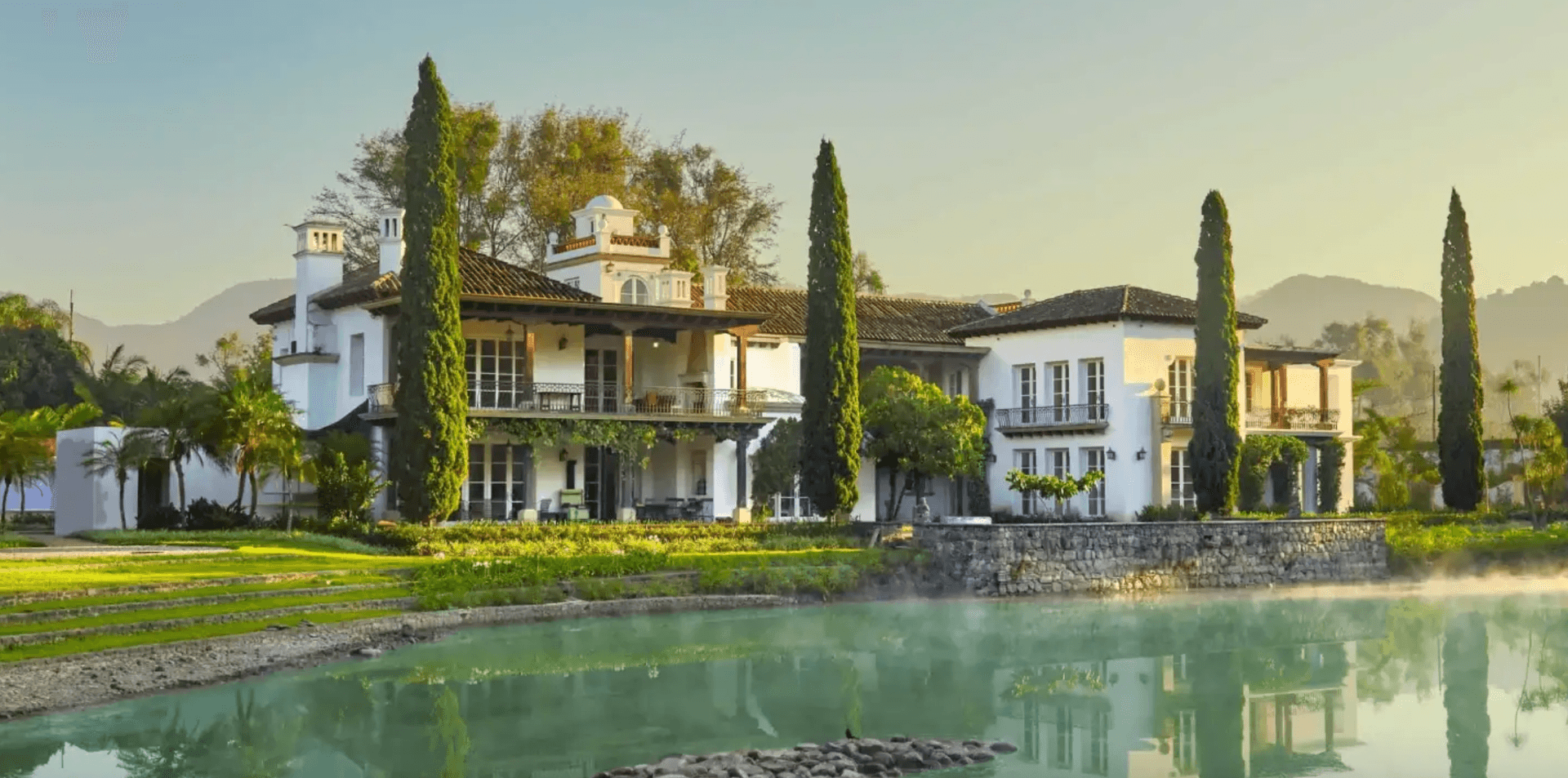
Villa Bokéh opened in 2020 as Antigua's only Relais & Châteaux member. It was designed by Paliare Studio architects for Grupo Alta — the hospitality group led by Claudia Bosch — on a former artist's private estate that has been immaculately reimagined as a luxury hotel while retaining all the unhurried quality of a personal residence. It earned a place on the Condé Nast Traveler Hot List in 2022. It has been, quietly and deservedly, filling up ever since.
The property occupies six acres of manicured gardens outside the city — lily ponds, stone bridges, a gazebo, a lakeside solarium, cascading water features — all oriented so that the dominant view, from nearly every vantage point on the grounds, is of Agua rising behind it all. The hotel building itself is four stories of colonial architecture interpreted through a contemporary and minimalist lens: natural materials, neutral tones, geometric restraint, punctuated by an extensive collection of works by Guatemalan artists that the owners have placed throughout the common areas and into every room.
The fifteen individually decorated rooms and suites — ranging from Deluxe to Master Suite — each blend modern comfort with traditional craftsmanship. Smart technology, air conditioning, organic local toiletries, and thoughtful amenities sit alongside hand-woven textiles, hand-thrown ceramics, and paintings sourced from around the country. The effect is neither museum nor boutique hotel cliché: it feels curated by someone who actually lives here and cares.
The Pool, the Spa, the Table
The pool area deserves its own paragraph because it is, frankly, exceptional. Surrounded by mature palms and serviced by a swim-up bar, with both hot and cold jacuzzis and a firepit for evenings that turn cool, it occupies the gardens in a way that feels proportional rather than resort-scaled. The poolside grill runs a menu of ceviche, pizza, and anything cold that requires nothing from you except presence.
The spa, housed in an intimate standalone structure, offers treatments drawn from Mayan healing traditions alongside contemporary therapies. The signature tub ritual — a ceremonial soak that incorporates local botanicals and indigenous techniques — has become something of a signature experience, and rightly so. Couples treatment rooms make it an obvious choice for the morning-after.
Dining at Villa Bokéh draws from the hotel's own gardens, with local produce and regional ingredients driving a menu that is explicitly Guatemalan in inspiration without being folkloric in execution. Breakfast is complimentary and runs from seven in the morning. Evenings in the dining room, with the mountains visible from the windows and candlelight across everything, have a natural formality that requires no effort from the guests at all.
For the Wedding Itself
Villa Bokéh does not host weddings casually. Couples who choose the property for their celebration will book the entire hotel — all fifteen rooms — creating a private-house experience that is fundamentally different from hosting an event in a resort's function suite. Your guests become residents. The grounds become yours.
The gardens have hosted ceremonies beside the lagoons and under the volcano, cocktail hours along the garden terraces, and receptions in tented structures that couples and their planners have transformed into something spectacular — crystal chandeliers suspended from draped fabric, long tables under open sky, marimba musicians giving way to dancing that goes until the gardeners arrive in the morning.
The ceremony itself can take place in any number of configurations on the grounds, but the most dramatic — and therefore the most popular — positions the couple with Agua directly behind them, the mountain serving as an altar backdrop that no florist on earth could improve upon.
For couples wishing to incorporate the ruins that make Antigua so cinematically distinctive, the choreography of a ceremony at the atmospheric arches of La Merced or the crumbling grandeur of the Convento Santa Clara, followed by a reception at Villa Bokéh, is increasingly common — and consistently extraordinary.
The City Itself: What Your Guests Will Remember
A destination wedding lives and dies by the quality of the week around it. Antigua is, on this front, abundantly generous.
The city's central park — Parque Central — anchors a grid of cobblestone streets that rewards wandering: the Arco de Santa Catalina, the candy-colored arch straddling 5a Avenida Norte that appears in every photograph ever taken here; the Cathedral of San José, its earthquake-fractured facade a work of accidental modernism; the Convento de las Capuchinas, whose circular tower nuns' retreat is one of the architectural curiosities of the Spanish colonial world.
Coffee is inescapable, and that is a pleasure rather than an imposition. The volcanic soil and altitude of the Antigua valley produce beans that coffee specialists travel specifically to source, and the city's cafes make the most of this with a seriousness that the third-wave movement has only recently begun to match.
For guests who want to stretch beyond the city, the options are elemental. A sunrise hike up Acatenango — a full-day climb to one of the highest peaks in Central America, with Fuego erupting across the saddle throughout — is one of the more legitimately astonishing experiences available anywhere in the world. Coffee finca tours run from several estates within thirty minutes of the city center. And, within two hours, there is a lake that is widely regarded as one of the most beautiful places on the planet.
Which brings us to what happens after.
Lake Atitlán: The Honeymoon Premise
The geologist's description of Lake Atitlán does it justice in its own cold way: a caldera lake formed by a massive volcanic eruption approximately 84,000 years ago, its surface sitting at 5,124 feet above sea level, its depths reaching more than 1,000 feet, surrounded by three active volcanoes — Tolimán, Atitlán, and San Pedro — that rise from its southern shore. The water is the color that travel writing usually reserves for the Mediterranean, except that no Mediterranean lake has volcanoes.
It is, in any honest accounting, one of the most spectacular bodies of water on earth.
The small communities strung along its shores — San Marcos, San Juan, San Pedro, Panajachel, Santiago Atitlán — each carry a distinct character and indigenous culture, with Maya Tz'utujil and Kaqchikel traditions that have remained remarkably coherent through five centuries of colonial disruption. The lake connects them not by road, which is slow and circuitous, but by lancha — small motorboats that cross the water in minutes and are the actual infrastructure of daily life here.
The village of Santa Catarina Palopó, on the eastern shore, is known across Guatemala for the way its residents have painted the facades of their homes in brilliant blues and purples, the color of the huipiles woven here. It sits at kilometer 6.8 of the road from Panajachel to San Antonio Palopó. The address is the point.
Casa Palopó: The Destination at Kilometer 6.8
The name of the restaurant on the main terrace of Casa Palopó is 6.8 — the kilometer marker that has become a kind of shorthand for the address, the altitude, the altitude above sea level, and the fact that precision matters in a place this specific. It is a detail that tells you what kind of hotel this is.
Casa Palopó began as a private home. Built and furnished by art collectors with a genuine eye and a commitment to the local Guatemalan craftwork tradition, it became the country's first — and still its only — Relais & Châteaux property, a designation that signals less a standardized quality threshold than a particular philosophy about hospitality: small, personal, rooted in place, committed to the table.
Forbes has described it as one of the world's most secluded honeymoon destinations. Mr & Mrs Smith includes it among its recommended luxury hotels. Neither characterization captures what is actually distinctive about the property, which is simply that it feels like staying in someone's extraordinarily well-considered home on the edge of the most beautiful lake in Central America.
The Rooms
The fifteen individually designed accommodations divide between the original main building and a private villa perched above it on the hillside. In the main house, the rooms feature stucco walls in Moroccan blue and terracotta, exposed wooden ceiling beams, terracotta floors, Italian linens, and contemporary indigenous artwork that manages to avoid every trap of ethnographic decoration. Each is different. The Master Suite Atitlán, upstairs in the villa with its own private staircase, has become something of a legend — a four-poster bed, a large soaking tub, a shower oriented directly toward the lake, and multiple distinct spaces for reading, working, sitting in silence.
The private villa, available for exclusive use with private chef and butler service, comes with its own heated infinity pool, jacuzzi, living room, and kitchen. For a honeymoon, it is an argument that is difficult to counter.
Views everywhere, from every room with a terrace or window facing the water, frame the same improbable tableau: the lake, the volcanoes, and the shifting light that moves across it all from first sun until the sky goes completely dark and the stars, at this altitude and in this darkness, become genuinely absurd.
Restaurant 6.8
Chef Manuel Martín del Campo's kitchen occupies a glassed terrace cantilevered over the lake's edge, its tables oriented to catch the sunset across the water. The menu draws from local farms and nearby markets, producing a cuisine that is simultaneously modern and unmistakably of this place — ceviche, risotto, dishes that build from Guatemalan ingredients with technique that has nothing to prove. The wine list is short and thoughtful. The service is warm in the way that characterizes Central American hospitality at its best — present without performance.
Breakfast, served in the same space, is a somewhat more modest affair, worth noting for those whose expectations after dinner run high. The surrounding is extraordinary at any hour.
The afternoon tea experience, with Guatemalan chocolate and local pastries served on the terrace with the lake below, is the kind of thing that does not need to be extraordinary to be perfect. It simply is.
Kinnik: Fire, Lake, and the Other Meal You Will Not Stop Talking About
Casa Palopó's second restaurant is a different kind of proposition entirely — and the fact that it occupies a position at the water's edge, suspended between the terrace garden and the lake itself, tells you something about the ambition behind it.
Kinnik takes its name from Kinich Ahau, the Maya Sun God, which is both an act of cultural homage and an entirely accurate description of what powers the kitchen: fire. Open fire, to be specific — the primal, elemental kind that predates every culinary technique that has been fashionable in the last century, and that Chef Jorge Peralta has spent his career learning to wield with the precision of something far more refined.
Peralta is Guatemalan by birth and visionary by formation — trained across Latin America, absorbing techniques rooted in Peru, Mexico, and Spain before returning to his own country with a focused intention: to show what Guatemalan ingredients, drawn from the twelve villages surrounding the lake, could become in the right hands over the right flame. His menus at Kinnik are built around meat maturation and open-fire cooking, but the thinking behind them reaches into every corner of the region's agricultural and culinary tradition.
The space itself, designed by Katina Jongezoon of Katy Jay Studio, arrives with the confidence of a restaurant that knows exactly what it is. Bright yellows and golds anchor the palette — not the restrained earth tones of the main house but something bolder, a whimsical ceiling mural and a checkered statement wall that signals, before you have looked at a menu, that this is not an extension of Restaurant 6.8 but a deliberate counterpoint to it. Private deck, lounges, terrace space for twelve, a private table for seven, the main room for thirty-two — and the lake, always the lake, filling whatever space the walls do not.
Dinner begins with the picoteo — Guatemalan chorizo and longaniza alongside melted cheese, beans, guacamole, and fresh tortillas — a starter that is simultaneously modest and exactly right, the kind of thing that recalibrates your expectations for what follows. What follows is fire: tenderloin, skirt steak, and ribeye, grilled over open flame and served with chargrilled vegetables, gorgonzola cream cauliflower, and specialty sauces — chipilin béarnaise, chirmol, chimichurri — that demonstrate how confidently Guatemalan culinary tradition holds its own against anything borrowed from elsewhere. Tableside carving and small table grills are available for those who want to participate in the meal rather than simply receive it. The dessert of crepes filled with goat milk caramel and caramelized pears arrives without fanfare and does not require any.
Sunday brunch — specialty bacon pancakes, huevos rancheros, avocado toast with Guatemalan togarashi — has become a destination in its own right, drawing guests from across the lake as much as from the hotel itself. Kinnik is open to the public, which means the couple willing to plan around Wednesday-to-Saturday lunch and dinner service, or a long Sunday morning on the terrace with the volcanoes in the distance, has access to one of the more interesting meals currently being cooked in Central America.
"I'm inspired by the culture, my environment, and the elements," Chef Peralta has said of the concept. "At Kinnik, we are able to achieve something that feels traditional, yet elevated."
It is a precise description of what they have built.
What to Do With All That Time
Casa Palopó is not, in its essential character, an activities hotel. It is a place to stop.
That said, for honeymooners who need more than a terrace and a view, the property's curated experiences reach into everything that makes the lake and its surrounding communities distinctive. Sound healing sessions with local practitioners. Yoga on open platforms above the water. Blessing ceremonies with Mayan shamans whose practice draws from traditions that predate the arrival of the Spanish by centuries.
Boat trips across the lake, offered privately, connect guests to the villages on the far shore — San Juan, with its artist cooperative and natural dye workshops; San Marcos, with its spiritual retreats and waterfront cafes; Santiago Atitlán, where the Tz'utujil tradition of the deity Maximón still draws both believers and the genuinely curious.
For those who require physical effort: all three of the volcanoes ringing the lake can be hiked, each at a different grade of commitment, all delivering views that justify every step.
The Community, Quietly
One of Casa Palopó's more unusual qualities is the depth of its investment in the communities around it. The owners, over the course of their tenure, organized and funded the painting of 850 village homes in Santa Catarina Palopó in the vivid blues and purples that now define the village's identity — a cultural and aesthetic contribution that has genuine permanence. They support local schools and artisan communities in ways that don't end up in the press materials. The hotel's staff, largely from the surrounding villages, bring a quality of warmth and knowledge to the hospitality that no training program engineers.
It is the kind of thing you notice over the course of a few days, gradually and with increasing certainty, that you are somewhere that cares about being somewhere.
The Itinerary, in Brief
For couples considering this particular sequence, a loose architecture of the celebration week might look something like this:
Arrive at La Aurora International Airport in Guatemala City — one hour from Antigua by car, easy direct connections from most major U.S. cities. Guests settle into Villa Bokéh and the surrounding hotels in Antigua for three to four nights: colonial ruins, coffee tours, volcano hikes, and the pre-wedding programming that distinguishes a great destination event from a wedding with a backdrop.
The wedding day — ceremony at ruins or in the gardens, reception under the stars at Villa Bokéh, the volcano present throughout, the marimba playing into the night.
Two days later, transfer to Casa Palopó. Two hours from Antigua by car along a road that descends through cloud forest before the lake appears, suddenly and without warning, below you. Ten days is not too many. Five is a minimum.
This is, in the considered view of everyone who has done it, the correct order of operations.
Thinking About a Destination Wedding in Guatemala?
My Venue Pilot specializes in sourcing and planning destination events at properties like Villa Bokéh and Casa Palopó — properties where relationships matter and the difference between a good experience and an exceptional one is who places the call.
If you are beginning to think seriously about a destination wedding in Antigua Guatemala, or a corporate retreat or incentive program in this region, we would welcome the conversation.